"If you have come here to help me, then you are wasting your time. But if you have come here because your liberation is bound up in mine, then let us work together" -Lilla Watson, Aboriginal Activist

Monday, November 28, 2011

Happy Thanksgiving!

10 things I'm (belatedly) thankful for this year:
  1. I'm thankful for my amazing family and friends back home who I missed so dearly over the holiday.  Without their undying support and encouragement, I'm not sure where I'd be. 
  2. All the amazing people I've met, relationships I've formed, places I've seen, and experiences I've had over the last 19 months.  
  3. All the mistakes I've made and learned from, the bad days I've survived, the loneliness and self-doubt I've overcome, and the many rough patches I've gone through over the last 19 months.  After all, it's hard to to appreciate the good without the bad. 
  4. I'm thankful for all my loyal blog-readers out there.  As of this week, Cartas de Lejos is 10,000 views strong.
  5. For beans, cabbage, eggs, veggies and fruit.  The Guatemalan diet isn't too shabby.
  6. For all of the lessons I've learned from the people in my village.  For all the love and respect they've given me that I never feel I truly earned.  For all the good days in site, that kept me going through year one and will keep me going through year two.
  7. I'm thankful for all the amazing Peace Corps friends I've made despite geographic barriers and hardly ever seeing one another.  Especially for those who I know I can call and cry to on the bad days.
  8. I'm thankful that in around 12 hours and about $10-20 worth of bus tickets, I can swim in the Caribbean Sea, the Pacific Ocean, or cross the border into in Honduras, Belize, El Salvador, or Mexico.
  9. I thankful that I was able to spend my Thanksgiving day 2011 hiking barefoot through the muddy jungle, climbing a waterfall, laying on a dock chatting about nothing for hours, and eating a Thanksgiving feast of local Tapado (Coconut-fish soup), Coconut bread, and not-so-local Chocolate Pudding Jelly Bellies.
  10. And last but not least, I'm thankful for Marie Sharp's Belizean Fiery Hot Habanero Pepper Sauce, and that it made it back in my backpack unbroken.

*Since drafting this I heard that six of the girls that I spent this weekend with were held up at gunpoint on their bus ride home yesterday afternoon.  They are all okay, although understandably shaken up, and dealing with getting their stolen phones and credit cards replaced.  From what I've heard from them they are handling it extremely well--that's after all what PCV's are really good at--not letting the ugly and sometimes scary realities of living and working in a developing country overshadow the amazing times and experiences we have here.  So I'll add an eleventh "I'm thankful for" and say that I am so so thankful that my friends are safe and okay.  I know that they'll all bounce back from this with characteristic grace because that's just how strong and independent they are.  

Tuesday, November 22, 2011

Another chance to help


This is Any (pronounced like Annie with a soft "a") Cordova Caal, a 16-year old recent graduate of Tercero Básico, the Guatemalan equivalent to 9th grade.  Out of over 50 of her peers, she was one of only 24 to pass the final exams, and has one of the highest averages.  She's an amazing student--driven, hardworking--and wants badly to continue her education.  She would like to enroll in Emilio Rosales Ponce Magisterio (teacher training) program, located in the city of Coban, a 2-hour drive from Campur.  In order to study there, she will need to live in Coban, rent a room, pay for food, etc.  One of the realities of living in an Indigenous, rural village in Guatemala is that oftentimes higher education doesn't come to the students; the students have to go to the education.

Any comes from a very poor, single-parent home and desperately needs financial assistance to be able to afford the cost of going to Magisterio.  She explains (translated from Spanish):

"Five years ago my father abandoned us, he mortgaged off the house where we were living and the little bit of land that we owned.  My mother couldn't make the mortgage payments so we lost everything.  Right now we all live in a small one-roomed wooden house that my mother had built with the little money she earned working.  My mother is who has raised us, she has fought hard to make sure that we are alright, but she is a housewife who doesn't know how to read or write.  Everyday she gets up early and sells food in front of the Health Center, sometimes failing, which leaves her exhausted.  My father currently lives in the capitol city where he has another wife and three more children.  Sometimes he sends us money--between Q300-Q400--and when it gets very bad he has us call him so that he can send us some more.  Both of my brothers are ready to enter into middle school, but only the younger one will go because my mother can't cover the costs of sending both of them to school.  My older brother will instead work for a few years and save some money for his studies."

"I want to continue studying--becoming a teacher is my dream--the thing that really made me choose this career path was the huge problem of Education that we have today in Guatemala.  There are still so many illiterate people, and I want to be a part in developing my own country and helping the people that most need it, those in my own community.  I'm a creative person with an open-mind, and I would like put these skills to use in bettering my community.  As a recent graduate I want to work, to volunteer my knowledge, demonstrate my skills in a school setting as well as help illiterate people in my community to read and write.  My other goal is to help my mother and give her the best, as she has worked so hard for me and my three siblings.  I also want to make sure that all of my siblings can continue their studies."

I have coordinated with the Director of Any's middle school and the wonderful people at Friends of Guatemala (FOG) to set up a scholarship fund for Any's education.  Below is the annual budget of what it will cost Any to study for one year in the teacher-training program.  Her mother has agreed to do all she can to pay for a little less than half of the total cost. 


One Time Costs

Inscription
Q150
Uniform
Q500
Books/Supplies
Q200
One-time costs total
Q850
Monthly Costs

Rent
Q400
Food
Q400
Supplies
Q200
Travel
Q80
Monthly Costs Subtotal
Q1080
Monthly Costs x 10 months=Monthly Total
Q10,800
Annual Total (one-time costs + monthly costs)
Q11,650
 Minus Family Collaboration @ 45%
-Q5,243
To be fundraised:
Q6,407
= $820.00

Let's rally our forces and send Any to Magisterio!!  If you are unable to make a donation at this time, please help by spreading the word and forwarding this page to those who may be able to help!

All donations are tax deductible and will go directly to Any in the form of a monthly scholarship payment.

Donations should be sent to:

Friends of Guatemala          
P.O. Box 33018
Washington, D.C. 20033

*Please write “Any Caal – Cat. II” in the subject line of the check so that Friends of Guatemala know which scholarship student the donation is for.

Questions?  Email me at hgdalman@gmail.com.

Thank you for your support and Happy Thanksgiving!!

From left: Any, Elsa, Sandra, and me


Friday, November 11, 2011

Driving Miss Daisy

I've gotten in the habit of taking the tourist shuttle between my site and Santa Lucia when I travel for Peace Corps business.  Caesar, one of the drivers/owners of the shuttle company, is really great with PC volunteers and cuts us a great discount.  He also picks me up on the side of the highway outside of my site and takes me directo--it's just so nice not having to worry about changing buses three times, or being the victim of the oh-too-frequent bus robberies.

Yesterday I had arranged to go back on the 2:00pm shuttle, and waited patiently in the burning sun at the Santa Lucia bus terminal.  An hour later the shuttle arrived, with a happy Caesar aboard.  Upon putting my backpack on the roof, and making sure I was settled in nicely, Caesar casually told me "Alright, I'm going to stay here. You'll be the guide, right Hannah? My friend here who's driving never goes this route so you'll guide him. See you soon!"  And with that, he pulled the sliding door shut and off we went.  I looked around--a van full of German tourists.  I looked at the driver in the rear view mirror, and he caught my eye and said "Caesar says you've done this trip many times. I'll need your help getting through Guate."  I laughed, as reality began to sink in.  This driver and van full of Germans were counting on me to get them to Coban.  Me, one of the most bona fide directionally-challenged women of this century.  This is something I know, and that everybody who knows me well enough knows.  Back home, I GoogleMap everything.  I still find myself chanting "Never Eat Soggy Waffles" to remember my cardinal directions.  I've lived in Chicago my entire life and I still sometimes get on the bus or train going in the wrong direction.

As I sat there pondering the hilarity of the situation, the driver caught my attention to ask which way to veer in an oncoming fork in the road.  Soon enough, I was hanging over the back of the driver's seat, squinting out the windows trying desperately to recognize anything familiar on the side of the Guatemalan freeway.  And somehow between the driver's common sense, my recognition of a few key landmarks, and a few desperate calls to Caesar for help, we got out of Guate and onto the main highway, where we started the straight-shot, no-brainer journey up to Coban.

As I sat back and took a sigh of relief, I realized that this seemingly ridiculous situation represented so many other experiences I've had here as a PC volunteer.  So often here I've found myself back-seat driving for a Guatemalan on a route that I only know a little bit better than he or she.  I've found myself having to put on my expert hat in so many situations in which I've felt as far from a expert as possible.  I've "taught" Guatemalan women how to use a dutch-oven when it was only the second time ever using one myself.  I've taught middle-school lectures on self-esteem and goal-setting when I often question how well I do these things in my own life.  Construction workers have asked my approval on bottle-walls that were as new a concept to me as they were to them.  So much of my service here boils down to just that: back-seat driving on a route that I only sort of know.  I came here 18 months ago an expert in absolutely nothing.  But what I did come with was a willingness to learn, adjust, and go with the flow.  And with that, a bit of luck, and access to a plethora of resources, all I can do is just hope that my Guatemalan counterparts and I reach our destination together.  Or at least come a little bit closer to it that we were before.

Friday, November 4, 2011

Barriletes

It's around 5:00pm, and we're sitting in stop and go traffic (more stop than go) on the way from Sumpango to Zaragoza where I'll be spending the night.  Every year on November 1st--Dia de Todos Santos--there's the big kite festival in Sumpango, a pueblo about an hour's drive from the capitol.  Teams of people spend months crafting enormous kites out of tissue paper and bamboo and gather in Sumpango to display their craftsmanship and attempt to fly their design.  Some of the larger kites span over five meters in diameter and thus don't really fly--but they are a spectacle nonetheless.  There were rumors this year that one of the bigger kites crashed and injured a few spectators in the crowd.  We had already gone when this supposedly happened, but it wouldn't surprise me.  The largest kites are so bulky and the crowd stands so close, it's kind of an accident waiting to happen.  That seems to be an ongoing theme in Guatemala.  There are always a lot of accidents waiting to happen.  Maybe that's why nobody seems too surprised when they do.

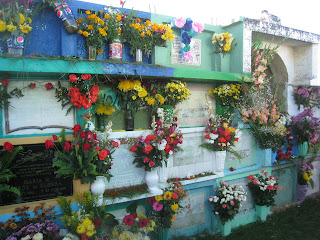
Some of the graves at the Sumpango cemetery.

We ventured through the Sumpango cemetery on the way back to the highway to wait for our bus.  Every single grave was lavishly decorated with flowers, colorful tissue paper, photos.  Families sat around their relatives' graves, hanging out, eating, perfecting their plastic-wrapped adornments.  All of this attention on the dead seemed to divert one's thoughts from the idea of death itself.  The melancholy nature of this holiday just doesn't occur to you when you're standing in front of a giant dandelion-colored sarcophagus covered in flowers and streamers and people.  Yet another Guatemalan occasion where tradition and painstaking procedure seem to overshadow the underlying event.

We continued on, eating our way through the narrow streets of Sumpango.  Guatemalan elephant ears covered in sticky honey, sweet cornbread tamales, brown-sugar boiled squash, piping hot cheese-filled papusas--street food is one of the greatest things about living in this country.  On the chicken bus we sat in our fought-for seats, and soon enough, by some combination of the vibration of the idling motor, the body heat of the other 90 people crammed tightly in the old school bus, and the dreariness from being out in the Sumpango sun all day (and possibly that elephant ear I washed down with a Gallo tall boy), I passed out, hard.  I woke up when we starting moving freely down the highway, realizing I was snuggled up in the paca-bought puff jacket sleeve of the Guatemalan man sitting next to me.  He was unfazed, and surprisingly, so was I.  I can't imagine what a fellow Chicagoan would do back home if I decided to take an impromptu blue line nap on their arm.  But here I've had a dozen Guatemalan strangers fall asleep on me.  This was my chance to cash in for my tolerant ways, and it was wonderful.  From now on, I will vow to sleep on as many shoulders as I want.  Because just as those kites took off into the air leaving behind their land-bound homes, I can branch out beyond my American personal-space-bubble and have a lovely little nap on a shoulder.

My favorite kite on display. Its caption reads:
"The life of mother nature lays in our hands."

Tuesday, October 25, 2011

Tuesday

I wake up early, 5:00am.  It's still dark, and too damp and chilly for a cold shower.  I sponge bathe in the pila, get my things ready, and go out to catch the 6:00am bus.  Olga told me yesterday that today they'll probably burn the "culpable's" house in retribution for don Mario's death last week.  So I thought it best to spend the day in Coban, run some errands, and avoid being witness to a lynching.  I need olive oil, after all.  Olive oil is as good a reason as any to avoid being caught up in an angry Guatemalan mob.  Sure enough, as my bus pulls out of the roundabout, a small mob of people head towards the guilty man's small pharmacy, and not fifteen minutes later, when I turn to look out the back window of the microbus, a column of dark smoke is rising from the middle of Campur.

Sunday was don Mario's funeral; Dilan and I watched the long, somber procession from my window.  Don Mario was a COCODE, or town leader, and apparently highly respected in Campur.  He was young, only 35 years old.  I spent three days asking around, hoping for a real answer to how and why he died.  After three days I had a story that's real only in the cultural context it was told in.  Apparently don Mario got into a bit of a land dispute with another man from town, don Carlos, who subsequently put a curse on don Mario, who had a "derrame cerebral" (which is either a brain hemorrhage or a stroke, I'm still not sure) and died in the hospital a few days later.  Rumors of a lynching have been circulating ever since he died, and don Carlos went into hiding.

I get back from Coban late in the afternoon and visit with Olga who catches me up with what happened.  "They tried to burn the pharmacy, which isn't actually his pharmacy but his brother's. But because it's made of block, only the wooden store next to it burned.  They found the guilty one and beat him.  He's in the hospital now; he was bleeding from his ear so he might die, too."  She got to go in to work late this morning, she tells me, since everybody went to go witness the burning there was no business on this side of town.  We talk about how it's a pity that an innocent's store was burned because of all of this, and that Don Carlos might die.  In hopes of lightening the mood, I dig in my bag and give her the box of microwave popcorn I bought her at the Walmart in Coban.  She just got a microwave through her Avon sales and has been talking about it for a week.  I explain to her that this popcorn is especially made just for microwaves like hers.  She opens the box and hands me a packet--"you take one, too, so you can make it in your microwave."  I don't have a microwave, I tell her, just an oven.  "You can't make this in the oven?"  No, I tell her, it's only for microwaves.  "But what's the difference between a microwave and an oven, then?" she asks me.  I stall for a minute, wondering how I'll ever be able to explain in Spanish how a microwave functions.  "A microwave simply agitates the food by zapping it with tiny waves until the food is so agitated that it heats up by itself"??  Hah.  I cop out and tell her that a microwave is able to get very hot very quickly which is why it can make the popcorn pop.  When everybody around me apparently believes you can curse a man into having a stroke, how can I expect anybody to understand the mechanisms of a microwave oven?  I may as well just claim that microwaves function on the same witchcraft that killed don Mario.  Would everybody burn their microwaves, then, too?

Friday, October 21, 2011

Friday

Nothing like a sunny Friday to pull me out of what's been a week-long slump.  I went to bed last night wearing wool socks, two fleeces, and sweats, and woke up to a beautiful, sunny morning.  Peace Corps lifted the Standfast today, as well, although with warning that another storm is threatening to pass through on Sunday.  I don't know if I can take another week of cold and rain.

I will try to stay positive, however, and focus on the good things in life.  Like sunshine, and all the good books I'm reading in this so-called slump of mine.  I also just got the news today that the Operation Groundswell volunteers finished the proposal for the Tzibal cancha project.  It's going to be a great project and I am continually impressed by the hard work and passion of these volunteers!  Please please please check out the website here and make your donation!

Tuesday, October 18, 2011

Tuesday

Standfasted yet again.  Yesterday the President declared the country under a "State of Calamity*" due to the damage done by the recent rains.  I suppose Peace Corps had little choice but to declare another standfast for all of its volunteers in response to this, but it doesn't make it any easier.  I try not to complain--I wasn't planning on traveling anyway; it's just hard to be reminded, over and over, that I have no real control over my life here.  I am a child of a governmental organization, and if they say jump, I better do it.  Luckily Campur and the surrounding areas have little to no damage--I've heard rumors of landslides further south on the highway towards Guatemala City, but nothing as bad as out in the Occidente.  In every bit of news I hear the death count gets higher and higher.  But as they always seem to do here, they will fix the roads, dig out their muddy villages, and continue on.  I can gripe all I want about being told I can't leave site, but I am safe, and I am dry.  I truly have nothing to complain about.

Today I went up to Tzibal for their very belated Dia del Niño celebration (it was postponed due to the Bottle School inauguration).  Dia del Niño (Children's Day) is a yearly celebration similar to Mother's Day and Father's Day, only this time it's celebrating the children.  The first I ever heard of Dia del Niño was back in training, when I was still living with my host family in San Bartolome.  Ladinos in particular tend to spoil the living daylight out of their children and this is what I saw all through training.  Child-rearing in a Ladino household, to my American eyes, seemed like utter chaos.  No structure, no rules, and never ever say "no."  Spanking the hell out of them with a rubber sandal is the only real disciplinary tactic.  No wonder I scoffed at the idea of having an entire holiday devoted to children.  "Everyday is children's day," I thought, thinking back to my own self-centered childhood and adolescence.  Now I think back and realize how wrong I was.  For families in rural Guatemala, el Dia del Niño is important.  Many of these children don't get much of a childhood; for those that do it's often cut quite short.  Whenever I take the 5:30am microbus out of Campur I'm greeted by the ayudante who opens the bulky sliding door for me and collects my fare.  He can't be older than eight or nine years old.  When children don't have jobs in the outside world, they're surely working in the homes, helping their mothers raise multiple children, tend a store, keep up with housework, what have you.  So yes, having a day to celebrate children, childhood, and education (as most Dia del Niño celebrations are coordinated by the local primary school) makes sense.  Up in Tzibal we had two piñatas, some games, and a Kak'ik lunch (which we owe to Plan Internacional for donating the chicken).  The school couldn't afford to make tortillas for the Kak'ik, so the students each brought a few from home to eat with their soup.  I of course didn't get this memo, but was just fine enjoying my soup sans-tortillas.  As we sat around eating, however, two little first grade girls came over and each handed me a cold tortilla.  I watched them go back to their seats and saw that they had given me their last ones.  I knew that trying to give them back would be ineffective and possibly rude so I ate them, recognizing that even on their day, these kids were still making sure that the gringa had her food.  My cheeks burned as I wondered whether my 7 year-old self was capable of that degree of selfless attentiveness.  My guess is no. 


*The last State of Calamity was announced in the aftermath of last year's tropical storm Agatha and the eruption of Volcan Pacaya.  I wonder if these are often a yearly event.